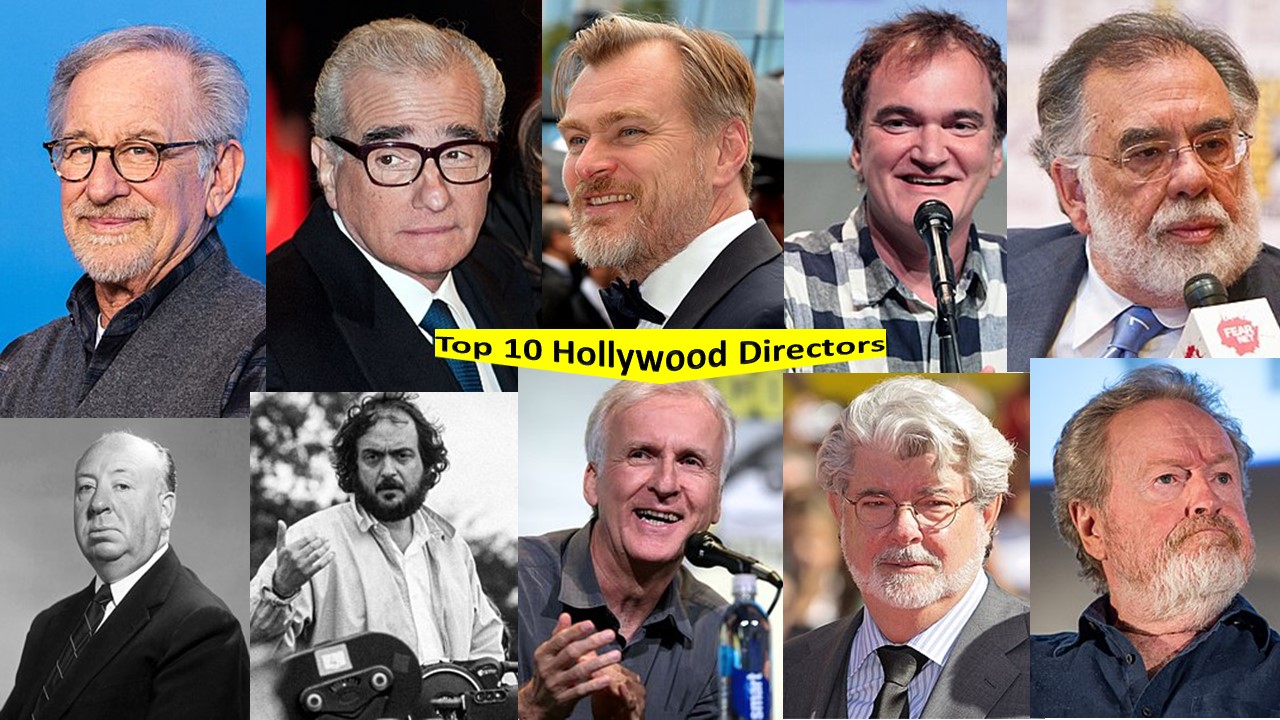
Introduction and List for Top 10 Hollywood Directors
Determining the “top” directors in Hollywood can be subjective and may vary depending on personal preferences and criteria. However, here is a list of ten highly acclaimed Hollywood directors known for their significant contributions to the film industry:
- Steven Spielberg: Renowned for his versatility and a wide range of successful films, including “E.T. the Extra-Terrestrial,” “Jurassic Park,” “Schindler’s List,” and “Saving Private Ryan.”
- Martin Scorsese: Known for his gritty, often crime-focused films, including classics like “Goodfellas,” “Taxi Driver,” and “The Departed.”
- Christopher Nolan: Celebrated for his complex and mind-bending films, such as “Inception,” “The Dark Knight” trilogy, and “Interstellar.”
- Quentin Tarantino: Known for his unique storytelling and iconic films like “Pulp Fiction,” “Kill Bill,” “Django Unchained,” and “Once Upon a Time in Hollywood.”
- Francis Ford Coppola: Famous for directing the “Godfather” trilogy, as well as “Apocalypse Now” and “The Conversation.”
- Alfred Hitchcock: Though no longer alive, Hitchcock’s influence on the film industry is immense, with classics like “Psycho,” “Rear Window,” and “Vertigo.”
- Stanley Kubrick: Known for his meticulous attention to detail and thought-provoking films, including “2001: A Space Odyssey,” “A Clockwork Orange,” and “The Shining.”
- James Cameron: Notable for his groundbreaking work in science fiction and blockbusters, such as “Titanic,” “Avatar,” and “Terminator 2: Judgment Day.”
- George Lucas: The creator of the “Star Wars” franchise and director of the original “Star Wars” film, “American Graffiti,” and the Indiana Jones series.
- Ridley Scott: Known for his visually stunning and genre-defining films, including “Blade Runner,” “Alien,” “Gladiator,” and “The Martian.”

Please note that the landscape of Hollywood directors is ever-evolving, and there are many talented directors who have made significant contributions to cinema. New directors continue to emerge with fresh and innovative storytelling, so the list of top directors can change over time.
Short Information and Wiki Links of Top 10 Hollywood Directors
Steven Spielberg
Steven Spielberg is one of the most renowned and influential directors in the history of Hollywood and global cinema. Born on December 18, 1946, in Cincinnati, Ohio, Spielberg’s career spans several decades, and his impact on the film industry is immeasurable. Here’s an overview of his life and career:
Early Life:
- Spielberg developed a passion for filmmaking at a young age and began making amateur films as a teenager.
- He attended California State University, Long Beach, but dropped out to pursue a career in the film industry.
Career Highlights:
- Spielberg’s breakthrough came with the release of his suspenseful thriller, “Jaws” (1975), which became a massive success and established him as a major director.
- In 1982, he directed the groundbreaking science fiction film “E.T. the Extra-Terrestrial,” which became one of the highest-grossing films of all time and further solidified his reputation.
- Spielberg’s collaboration with George Lucas led to the creation of the Indiana Jones franchise, beginning with “Raiders of the Lost Ark” (1981).
- He directed “Schindler’s List” (1993), a powerful and critically acclaimed film about the Holocaust. The film earned him an Academy Award for Best Director.
- Spielberg’s work on “Saving Private Ryan” (1998) also garnered critical acclaim and won him another Academy Award for Best Director.
- He has directed numerous other successful and iconic films, including “Jurassic Park” (1993), “The Color Purple” (1985), “Close Encounters of the Third Kind” (1977), and “Catch Me If You Can” (2002).
Innovations and Contributions:
- Spielberg is known for his mastery of diverse genres, including adventure, science fiction, drama, and historical epics.
- He co-founded Amblin Entertainment and DreamWorks SKG, two influential film production companies.
- Spielberg played a pivotal role in advancing the use of special effects and technology in filmmaking, notably in “Jurassic Park” and “Schindler’s List.”
- His ability to tell compelling stories and create memorable characters has made him a beloved and enduring figure in the film industry.
Legacy:
- Steven Spielberg’s impact on popular culture and the film industry is immeasurable. He is often cited as one of the greatest directors in cinematic history.
- He has received numerous awards, including multiple Academy Awards and Golden Globes, and has been recognized for his contributions to both entertainment and philanthropy.
- Spielberg continues to direct and produce films, remaining an influential figure in contemporary cinema.
Steven Spielberg’s career is marked by a remarkable combination of critical acclaim, box office success, and a lasting influence on the art of filmmaking. His ability to connect with audiences emotionally and tell compelling stories has cemented his legacy as a true cinematic legend.
Martin Scorsese
Martin Scorsese is a highly acclaimed and influential American film director, producer, screenwriter, and actor known for his distinctive style and his contributions to the world of cinema. Here is an overview of Martin Scorsese’s life and career:
Early Life:
- Martin Charles Scorsese was born on November 17, 1942, in New York City’s Queens borough, to Italian-American parents.
- He grew up in a neighborhood with a strong Catholic influence, which later played a significant role in his films.
Career Highlights:
- Scorsese’s career began in the 1960s, with his early works including “Who’s That Knocking at My Door” (1967) and “Boxcar Bertha” (1972).
- His breakthrough film was “Mean Streets” (1973), which introduced his signature themes of crime, guilt, and redemption. It also marked the beginning of his collaboration with actor Robert De Niro.
- Scorsese and De Niro worked together on several iconic films, including “Taxi Driver” (1976), “Raging Bull” (1980), “The King of Comedy” (1982), and “Goodfellas” (1990).
- “Raging Bull” is often regarded as one of Scorsese’s greatest achievements and earned him an Academy Award for Best Director.
- Scorsese’s diverse filmography includes “The Last Temptation of Christ” (1988), “Casino” (1995), “Gangs of New York” (2002), “The Departed” (2006), which won him his first Academy Award for Best Director, and “The Wolf of Wall Street” (2013).
Distinctive Style:
- Scorsese is known for his bold and often gritty storytelling, as well as his use of tracking shots, voice-over narration, and a dynamic editing style.
- His films often explore themes of violence, crime, moral ambiguity, and the complexities of human nature.
Passion for Film Preservation:
- Scorsese is a staunch advocate for film preservation and the restoration of classic films. He founded The Film Foundation in 1990 to support these efforts.
Recognition and Awards:
- Martin Scorsese is one of the most nominated directors in Academy Awards history and has received numerous accolades, including the Cecil B. DeMille Award for Lifetime Achievement.
Legacy:
- Scorsese’s impact on the film industry is immeasurable, and his films have left an enduring mark on cinema.
- He continues to be an influential figure in Hollywood, both as a director and as a mentor to emerging filmmakers.
Martin Scorsese’s career is characterized by his uncompromising vision, artistic innovation, and his ability to tackle complex and morally ambiguous subjects. His films remain an integral part of American cinema and continue to be celebrated for their storytelling, technical prowess, and exploration of the human condition.
Christopher Nolan
Christopher Nolan is a highly acclaimed British-American film director, producer, and screenwriter known for his innovative storytelling, complex narratives, and visually stunning films. Here is an overview of Christopher Nolan’s life and career:
Early Life:
- Christopher Edward Nolan was born on July 30, 1970, in London, England.
- He developed a passion for filmmaking at an early age, making short films with his father’s Super-8 camera.
Career Highlights:
- Nolan’s breakthrough film was “Memento” (2000), a psychological thriller that garnered critical acclaim for its non-linear narrative structure.
- He gained widespread recognition and acclaim for directing “The Dark Knight” trilogy, which includes “Batman Begins” (2005), “The Dark Knight” (2008), and “The Dark Knight Rises” (2012). “The Dark Knight” is particularly notable for Heath Ledger’s iconic portrayal of the Joker.
- Nolan directed “Inception” (2010), a mind-bending science fiction thriller that explores the concept of dreams within dreams. The film received critical acclaim and became a box office success.
- “Interstellar” (2014) marked Nolan’s foray into space exploration and science fiction, offering a visually striking and thought-provoking narrative.
- He directed “Dunkirk” (2017), a war film based on the Dunkirk evacuation during World War II. The film received widespread acclaim for its immersive storytelling and technical achievements.
- Nolan’s film “Tenet” (2020) delves into the concept of time inversion and features intricate action sequences.
Distinctive Style:
- Christopher Nolan is known for his intricate and non-linear narratives, often challenging audiences to engage with complex storytelling.
- He frequently explores themes of time, identity, memory, and the blurred lines between reality and illusion.
Technical Innovation:
- Nolan is known for his commitment to practical effects and a preference for shooting on film rather than digital formats.
- His films are celebrated for their groundbreaking visual effects and practical stunts.
Collaborations:
- Nolan has worked with a recurring ensemble of actors, including Christian Bale, Michael Caine, Cillian Murphy, and Joseph Gordon-Levitt.
Awards and Recognition:
- Christopher Nolan has received multiple Academy Award nominations and has been recognized for his contributions to the film industry with numerous awards and honors.
Legacy:
- Nolan is considered one of the most influential and innovative directors of his generation.
- His films have had a significant impact on popular culture, and he has a dedicated fan base.
Christopher Nolan’s career is marked by his ability to combine thought-provoking concepts with commercial success, making him a prominent figure in contemporary filmmaking. His commitment to practical filmmaking techniques and his ability to challenge and engage audiences with complex narratives have solidified his place in the pantheon of great directors.
Quentin Tarantino
Quentin Tarantino is a highly influential American film director, screenwriter, producer, and actor known for his distinctive and innovative approach to filmmaking. Here is an overview of Quentin Tarantino’s life and career:
Early Life:
- Quentin Jerome Tarantino was born on March 27, 1963, in Knoxville, Tennessee, USA.
- He dropped out of high school but continued to educate himself through his love for cinema and literature.
Career Highlights:
- Tarantino’s directorial debut came with “Reservoir Dogs” (1992), a crime thriller known for its non-linear narrative and sharp dialogue.
- His breakthrough film, “Pulp Fiction” (1994), won the Palme d’Or at the Cannes Film Festival and became a cultural phenomenon. It is celebrated for its unique storytelling structure and memorable characters.
- “Pulp Fiction” was followed by a series of successful and influential films, including “Jackie Brown” (1997), “Kill Bill: Vol. 1” (2003), and “Kill Bill: Vol. 2” (2004).
- Tarantino’s “Inglourious Basterds” (2009) and “Django Unchained” (2012) received critical acclaim and won Academy Awards for Best Original Screenplay.
- He directed “The Hateful Eight” (2015), a Western film known for its ensemble cast and suspenseful storytelling.
- Tarantino’s ninth film, “Once Upon a Time in Hollywood” (2019), received widespread acclaim and earned him another Academy Award for Best Original Screenplay.
Distinctive Style:
- Quentin Tarantino is known for his unique blend of genres, witty and often profanity-laden dialogue, and graphic violence.
- He often pays homage to and references other films, genres, and pop culture in his work.
Cinematic Influences:
- Tarantino is heavily influenced by the works of directors like Sergio Leone, Akira Kurosawa, and Jean-Luc Godard, as well as the pulp fiction novels of the mid-20th century.
Impact on Cinema:
- Tarantino’s films have had a significant impact on contemporary cinema and have influenced a generation of filmmakers.
- He is credited with revitalizing the careers of several actors and introducing new talent to Hollywood.
Awards and Recognition:
- Quentin Tarantino has received numerous awards and nominations, including Academy Awards, Golden Globe Awards, and BAFTA Awards.
Legacy:
- Tarantino is considered one of the most influential and iconic directors of his generation.
- His films are celebrated for their boldness, originality, and ability to push boundaries.
Quentin Tarantino’s career is characterized by his passion for cinema, his unapologetic style, and his ability to craft films that are both artistically ambitious and commercially successful. His impact on filmmaking and storytelling continues to be felt in the industry, making him a prominent and enduring figure in Hollywood.
Francis Ford Coppola
Francis Ford Coppola is a highly esteemed American film director, producer, screenwriter, and entrepreneur known for his significant contributions to cinema. Here is an overview of Francis Ford Coppola’s life and career:
Early Life:
- Francis Ford Coppola was born on April 7, 1939, in Detroit, Michigan, USA.
- He was raised in a creative family, with his father, Carmine Coppola, being a composer and his mother, Italia Coppola, an actress and musician.
Career Highlights:
- Coppola gained recognition as a filmmaker with “The Godfather” (1972), a crime epic based on the novel by Mario Puzo. The film became a cultural phenomenon and won several Academy Awards, including Best Picture.
- He followed “The Godfather” with “The Godfather Part II” (1974), which received even greater acclaim and won multiple Oscars, including Best Picture. Coppola won the Academy Award for Best Director for both films.
- Coppola directed “Apocalypse Now” (1979), a war film inspired by Joseph Conrad’s “Heart of Darkness.” The film was praised for its visionary and immersive storytelling.
- He also directed “The Conversation” (1974) and “The Outsiders” (1983), among other films.
Challenges and Innovations:
- “Apocalypse Now” faced numerous production challenges, including typhoons and budget overruns. However, it remains a landmark in filmmaking and is celebrated for its exploration of the human psyche during wartime.
Cinematic Style:
- Coppola is known for his meticulous attention to detail, visually striking cinematography, and complex characters.
- He often delves into themes of power, family, and the human condition.
Personal Projects and Winemaking:
- In addition to his filmmaking career, Coppola owns a winery and has ventured into the wine business. He is the proprietor of Francis Ford Coppola Winery.
Awards and Recognition:
- Francis Ford Coppola has received numerous awards, including Academy Awards, Golden Globe Awards, and the prestigious Irving G. Thalberg Memorial Award.
Legacy:
- Coppola’s contributions to the art of filmmaking have left an indelible mark on the industry.
- His work is celebrated for its storytelling depth and visual artistry.
Francis Ford Coppola’s career is marked by his directorial prowess and his role in creating some of the most iconic films in cinematic history. His ability to tackle diverse subjects and his commitment to storytelling excellence have solidified his place as one of the most influential directors in the world of cinema.
Alfred Hitchcock
Alfred Hitchcock, often referred to as the “Master of Suspense,” was a highly influential and iconic British-American film director and producer known for his pioneering work in the suspense and thriller genres. Here is an overview of Alfred Hitchcock’s life and career:
Early Life:
- Alfred Joseph Hitchcock was born on August 13, 1899, in Leytonstone, London, England.
- His early fascination with cinema and storytelling would later shape his career.
Career Highlights:
- Hitchcock began his filmmaking career in the silent film era in Britain. He directed numerous silent films before making his transition to sound films.
- He gained international recognition with films like “The 39 Steps” (1935) and “The Lady Vanishes” (1938), which showcased his knack for suspense and storytelling.
- Hitchcock’s move to Hollywood in the late 1930s opened up a new chapter in his career. He directed a series of acclaimed films, including “Rebecca” (1940), “Notorious” (1946), and “Strangers on a Train” (1951).
- Some of Hitchcock’s most iconic works include “Rear Window” (1954), “Vertigo” (1958), “North by Northwest” (1959), and “Psycho” (1960).
- “Psycho” is perhaps his most famous film, known for its shocking plot twists, groundbreaking cinematography, and Bernard Herrmann’s iconic score.
Innovations and Style:
- Hitchcock was known for his meticulous planning and innovative filmmaking techniques.
- He was a pioneer in the use of suspense, visual storytelling, and editing, often referred to as “Hitchcockian” techniques.
- He made cameo appearances in many of his films, becoming a recognizable figure to audiences.
Television:
- Hitchcock’s influence extended to television, where he hosted the popular anthology series “Alfred Hitchcock Presents” (1955-1965).
Awards and Honors:
- Despite his immense influence and contributions to cinema, Hitchcock received his only Academy Award for Best Director for “Rebecca.”
Legacy:
- Alfred Hitchcock is regarded as one of the greatest directors in the history of cinema.
- His films continue to be celebrated for their suspense, psychological depth, and storytelling prowess.
- Hitchcock’s influence on the thriller and suspense genres can be seen in the work of numerous filmmakers who followed him.
Alfred Hitchcock’s legacy is defined by his enduring impact on filmmaking and his ability to captivate audiences with his mastery of suspense and storytelling. His films remain classics that continue to thrill and entertain audiences worldwide, cementing his status as a cinematic legend.
Stanley Kubrick
Stanley Kubrick was an iconic American film director, producer, screenwriter, and cinematographer known for his distinctive visual style, meticulous attention to detail, and innovative storytelling. Here is an overview of Stanley Kubrick’s life and career:
Early Life:
- Stanley Kubrick was born on July 26, 1928, in New York City, USA.
- His early interest in photography and cinema laid the foundation for his later career in filmmaking.
Career Highlights:
- Kubrick began his filmmaking career as a photographer for Look magazine before transitioning to short films and feature films.
- He gained recognition with films like “Paths of Glory” (1957) and “Spartacus” (1960), which showcased his directorial talent and storytelling abilities.
- Kubrick’s groundbreaking work in “Dr. Strangelove or: How I Learned to Stop Worrying and Love the Bomb” (1964) blended dark satire with political commentary during the Cold War era.
- “2001: A Space Odyssey” (1968) is considered one of his masterpieces and is celebrated for its groundbreaking visual effects, music, and exploration of human evolution.
- Kubrick directed the dystopian crime film “A Clockwork Orange” (1971), which both shocked and fascinated audiences with its provocative themes.
- His adaptation of Stephen King’s novel “The Shining” (1980) is a landmark in the horror genre, known for its atmospheric tension and iconic imagery.
- Kubrick’s war film “Full Metal Jacket” (1987) is acclaimed for its portrayal of the Vietnam War and the dehumanizing effects of combat.
- His final film, “Eyes Wide Shut” (1999), starring Tom Cruise and Nicole Kidman, explored themes of sexual obsession and marital discord.
Distinctive Style:
- Kubrick was known for his meticulous planning, extended production schedules, and perfectionism.
- He often employed long, unbroken takes and distinctive wide-angle lens cinematography.
Influence on Cinema:
- Stanley Kubrick’s films continue to influence filmmakers and artists across various genres.
- His ability to tackle diverse subjects and genres while maintaining a unique visual and narrative style has left an enduring mark on cinema.
Awards and Recognition:
- Although Kubrick was nominated for several Academy Awards, he won his only Oscar for Best Visual Effects for “2001: A Space Odyssey.”
Legacy:
- Stanley Kubrick is regarded as one of the most influential and innovative directors in the history of cinema.
- His films are celebrated for their depth, complexity, and thought-provoking themes.
Stanley Kubrick’s body of work reflects his dedication to pushing the boundaries of storytelling and visual artistry. His films continue to captivate and challenge audiences, and his legacy as a visionary filmmaker endures in the world of cinema.
James Cameron
James Cameron is a highly acclaimed Canadian filmmaker, director, producer, and screenwriter known for his groundbreaking work in the science fiction and action genres. He is renowned for his visionary storytelling and pioneering use of technology in filmmaking. Here is an overview of James Cameron’s life and career:
Early Life:
- James Francis Cameron was born on August 16, 1954, in Kapuskasing, Ontario, Canada.
- He developed a passion for science fiction and filmmaking from a young age.
Career Highlights:
- Cameron began his career as a visual effects artist and later transitioned to directing.
- He gained recognition with “The Terminator” (1984), a sci-fi thriller that launched his career as a director. The film introduced the iconic character of the Terminator and became a cult classic.
- Cameron directed “Aliens” (1986), the sequel to Ridley Scott’s “Alien.” The film was a critical and commercial success, earning Cameron his first Academy Award nomination for Best Director.
- His film “The Abyss” (1989) pushed the boundaries of underwater filmmaking and visual effects technology.
- Cameron’s “Terminator 2: Judgment Day” (1991) is considered a landmark in CGI and special effects. The film set new standards for action filmmaking and visual effects.
- He directed “True Lies” (1994), starring Arnold Schwarzenegger, blending action and comedy.
- “Titanic” (1997), a historical romance and disaster epic, became a global phenomenon and won 11 Academy Awards, including Best Director for Cameron. It held the record for the highest-grossing film of all time until Cameron’s own “Avatar” (2009).
- “Avatar” (2009) revolutionized 3D filmmaking and became the highest-grossing film in history, earning Cameron additional accolades and awards.
Innovations and Achievements:
- James Cameron is known for his commitment to cutting-edge technology and groundbreaking visual effects.
- He is a pioneer in underwater exploration and filmmaking, particularly with deep-sea exploration vehicles.
Environmental Advocacy:
- Cameron is an environmental activist and has used his filmmaking platform to raise awareness about environmental issues, particularly through documentaries like “Aliens of the Deep” and “Deepsea Challenge 3D.”
Legacy:
- James Cameron’s films are celebrated for their technical achievements, storytelling depth, and ability to push the boundaries of cinematic technology.
- He is considered one of the most successful and influential directors in the history of cinema.
James Cameron’s career is marked by his passion for innovation, exploration, and storytelling. His films have left a significant impact on the film industry and have garnered critical acclaim and commercial success worldwide.
George Lucas
George Lucas is an American filmmaker, producer, and entrepreneur who is best known for creating the iconic “Star Wars” and “Indiana Jones” franchises. His contributions to the film industry, particularly in the realm of science fiction and adventure, have made him a legendary figure in Hollywood. Here is an overview of George Lucas’s life and career:
Early Life:
- George Walton Lucas Jr. was born on May 14, 1944, in Modesto, California, USA.
- He developed an early interest in cars and filmmaking, which eventually led him to pursue a career in cinema.
Career Highlights:
- Lucas gained recognition with his breakthrough film, “American Graffiti” (1973), a coming-of-age comedy-drama set in the 1960s. The film was a commercial and critical success.
- However, it was his creation of “Star Wars” (later retitled “Star Wars: Episode IV – A New Hope”) in 1977 that catapulted Lucas to worldwide fame. The space opera introduced audiences to a galaxy far, far away and became a cultural phenomenon.
- Lucas followed “Star Wars” with two successful sequels, “The Empire Strikes Back” (1980) and “Return of the Jedi” (1983), creating the original “Star Wars” trilogy.
- In 1981, Lucas collaborated with director Steven Spielberg to create the “Indiana Jones” franchise, beginning with “Raiders of the Lost Ark.” The series includes several successful sequels.
- Lucas also founded Lucasfilm Ltd. and LucasArts, two prominent entertainment companies known for film production, special effects, and video game development.
Technological Innovations:
- George Lucas is credited with pioneering many technological advancements in filmmaking, particularly in the areas of special effects and computer-generated imagery (CGI).
- The creation of Industrial Light & Magic (ILM) and the development of THX sound technology are among his significant contributions to the industry.
Impact on Popular Culture:
- “Star Wars” has become one of the most successful and enduring franchises in film history, with a vast fan base and a significant impact on popular culture.
Philanthropy:
- Lucas has donated a substantial portion of his wealth to various educational and charitable causes, including the George Lucas Educational Foundation.
Legacy:
- George Lucas is celebrated for his imaginative storytelling, world-building, and his ability to create beloved characters and universes.
- His influence on the film industry, as well as his contributions to technological advancements in filmmaking, continue to be felt today.
George Lucas’s career is defined by his passion for storytelling, innovation, and creating cinematic experiences that have resonated with audiences for generations. His creative vision and dedication to pushing the boundaries of filmmaking have solidified his status as a legendary filmmaker.
Ridley Scott
Ridley Scott is a highly acclaimed British-American film director and producer known for his versatile filmmaking career and his contributions to various film genres. Here is a more detailed overview of Ridley Scott’s life and career:
Early Life:
- Ridley Scott was born on November 30, 1937, in South Shields, County Durham, England.
- He attended the Royal College of Art in London, where he studied graphic design and photography.
Career Highlights:
- Scott began his career in advertising, founding the production company Ridley Scott Associates (RSA) in the 1960s, which became known for its groundbreaking commercials.
- He made his feature film debut with “The Duellists” (1977), a historical drama set during the Napoleonic Wars. The film received critical acclaim and marked the beginning of his film directing career.
- Ridley Scott’s breakthrough came with “Alien” (1979), a science fiction horror film that became a major success and launched a popular franchise. The film’s atmospheric tension and iconic creature design contributed to its lasting influence.
- He followed “Alien” with “Blade Runner” (1982), a dystopian science fiction film that has become a cult classic. The film is celebrated for its visually stunning cyberpunk world and philosophical themes.
- Scott directed “Thelma & Louise” (1991), a feminist road film that received critical acclaim for its strong performances and social commentary.
- His historical epic “Gladiator” (2000), starring Russell Crowe, won the Academy Award for Best Picture and earned Scott an Academy Award for Best Director.
- Scott has directed several other notable films, including “Black Hawk Down” (2001), “Kingdom of Heaven” (2005), “American Gangster” (2007), and “The Martian” (2015).
Versatility and Style:
- Ridley Scott is known for his versatility as a director, having tackled a wide range of genres, including science fiction, historical drama, action, and crime.
- His films often feature striking visuals, meticulous attention to detail, and a keen sense of atmosphere.
Legacy:
- Ridley Scott’s impact on cinema is substantial, and his films continue to be celebrated for their storytelling and visual craftsmanship.
- He is considered one of the most influential directors in the industry, known for his ability to create immersive cinematic experiences.
Ridley Scott’s enduring career has left a lasting mark on the film industry. His films are not only successful commercially but also critically acclaimed, and his storytelling skills and visual artistry have made him a respected figure in the world of filmmaking.
Keynotes on Top 10 Hollywood Directors
Here are some keywords associated with the top 10 Hollywood directors mentioned earlier:
1. Steven Spielberg:
- Director
- Jaws
- E.T.
- Amblin Entertainment
- DreamWorks
- Special Effects
2. Martin Scorsese:
- Crime Drama
- Goodfellas
- Taxi Driver
- Robert De Niro
- Tracking Shots
- The Departed
3. Christopher Nolan:
- Inception
- Interstellar
- Dark Knight Trilogy
- Non-linear Storytelling
- Practical Effects
4. Quentin Tarantino:
- Pulp Fiction
- Kill Bill
- Pop Culture References
- Nonlinear Narratives
- Sharp Dialogue
5. Francis Ford Coppola:
- The Godfather
- Apocalypse Now
- Corleone Family
- American Zoetrope
- 1970s Cinema
6. Alfred Hitchcock:
- Master of Suspense
- Psycho
- Vertigo
- Cameo Appearances
- Thriller Genre
7. Stanley Kubrick:
- 2001: A Space Odyssey
- A Clockwork Orange
- Meticulous Attention to Detail
- Visual Style
- Genre Innovation
8. James Cameron:
- Avatar
- Terminator
- Titanic
- Visual Effects
- Science Fiction
9. George Lucas:
- Star Wars
- Indiana Jones
- Lucasfilm
- Industrial Light & Magic
- Pop Culture Icon
10. Ridley Scott:
- Alien
- Blade Runner
- Versatility
- Atmosphere
- Historical Drama
Further Readings for Top 10 Hollywood Directors
1. Steven Spielberg:
- Book: “Steven Spielberg: A Biography” by Joseph McBride
- Documentary: “Spielberg” (2017), directed by Susan Lacy
2. Martin Scorsese:
- Book: “Martin Scorsese: A Biography” by Vincent LoBrutto
- Documentary: “Scorsese” (2010), part of the “A Personal Journey with Martin Scorsese Through American Movies” series.
3. Christopher Nolan:
- Book: “The Nolan Variations: The Movies, Mysteries, and Marvels of Christopher Nolan” by Tom Shone
- Article: Explore in-depth interviews and articles in film magazines like Sight & Sound and Empire.
4. Quentin Tarantino:
- Book: “Quentin Tarantino: Interviews” edited by Gerald Peary
- Documentary: “Tarantino: The Disciple of Hong Kong” (1999), directed by Benny Chan
5. Francis Ford Coppola:
- Book: “The Godfather Effect: Changing Hollywood, America, and Me” by Tom Santopietro
- Documentary: “Hearts of Darkness: A Filmmaker’s Apocalypse” (1991), directed by Fax Bahr and George Hickenlooper
6. Alfred Hitchcock:
- Book: “Alfred Hitchcock: A Life in Darkness and Light” by Patrick McGilligan
- Documentary: “Hitchcock/Truffaut” (2015), directed by Kent Jones
7. Stanley Kubrick:
- Book: “Stanley Kubrick: A Biography” by Vincent LoBrutto
- Documentary: “Stanley Kubrick: A Life in Pictures” (2001), directed by Jan Harlan
8. James Cameron:
- Book: “James Cameron: Interviews” edited by Brent Dunham
- Documentary: “James Cameron’s Story of Science Fiction” (2018), a TV series exploring science fiction in film and television.
9. George Lucas:
- Book: “George Lucas: A Life” by Brian Jay Jones
- Documentary: “Empire of Dreams: The Story of the Star Wars Trilogy” (2004), part of the “Star Wars” DVD collection.
10. Ridley Scott:
- Book: “Ridley Scott: A Biography” by Vincent LoBrutto
- Documentary: “The Making of Gladiator” (2005), included in the “Gladiator” DVD release.