
Introduction, and List for Top 10 books to Read Before You Die
Reading is one of life’s greatest pleasures and a pathway to knowledge, understanding, and empathy. Throughout history, countless books have left a profound impact on readers, shaping their thoughts and perspectives. While individual tastes may vary, certain literary works have stood the test of time and continue to be recommended to readers around the world. The following list presents the top 10 books to read before you die, offering a diverse selection of genres and styles that have influenced generations and continue to inspire readers of all ages.
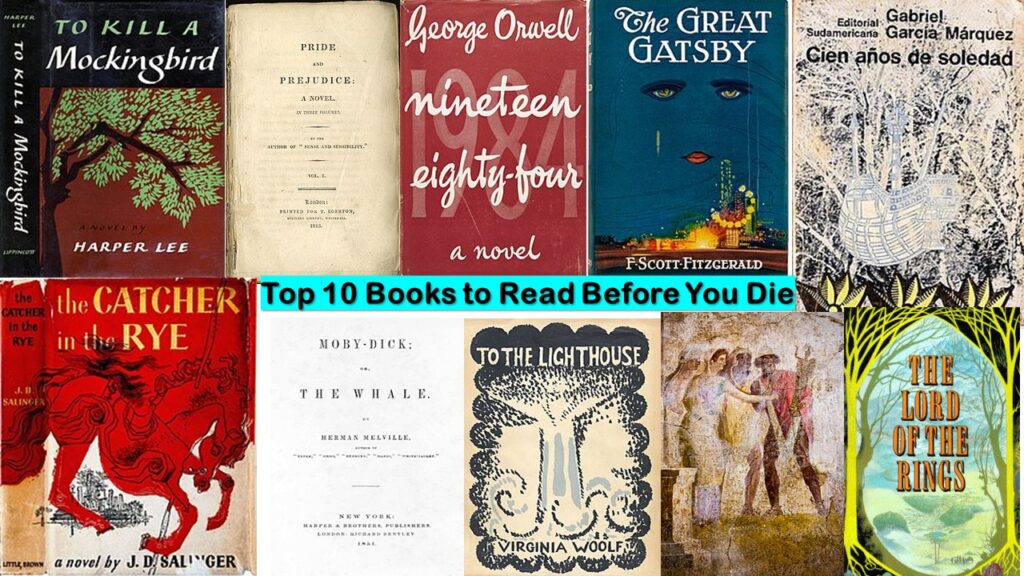
Top 10 Books to Read Before You Die:
- “To Kill a Mockingbird” by Harper Lee: Harper Lee’s timeless classic explores themes of racial injustice, moral growth, and empathy in the Deep South of the 1930s. Through the eyes of young Scout Finch, readers witness the power of compassion and courage in the face of prejudice.
- “Pride and Prejudice” by Jane Austen: Austen’s masterpiece delves into the complexities of class, manners, and love in Regency-era England. With wit and insight, the novel follows the spirited Elizabeth Bennet as she navigates societal expectations and her feelings for the enigmatic Mr. Darcy.
- “1984” by George Orwell: A chilling dystopian novel that warns against the dangers of totalitarianism and the erosion of individual freedom. Orwell’s portrayal of a surveillance state serves as a cautionary tale about the abuse of power.
- “The Great Gatsby” by F. Scott Fitzgerald: Set in the Roaring Twenties, this novel explores themes of wealth, love, and the American Dream. Through the eyes of Nick Carraway, readers are drawn into the enigmatic world of Jay Gatsby, a character whose pursuit of love and success ends in tragedy.
- “One Hundred Years of Solitude” by Gabriel García Márquez: A seminal work of magical realism, this novel weaves an epic tapestry of the Buendía family over several generations in the fictional town of Macondo. García Márquez’s lyrical prose transports readers to a world where reality and myth are intertwined.
- “The Catcher in the Rye” by J.D. Salinger: An influential coming-of-age novel that captures the angst and alienation of adolescence. Holden Caulfield’s journey through New York City resonates with readers, making it a timeless exploration of youthful rebellion and societal expectations.
- “Moby-Dick” by Herman Melville: This epic adventure follows Captain Ahab’s obsessive quest for revenge against the great white whale, Moby Dick. A profound exploration of human nature, the novel delves into themes of fate, obsession, and the complexity of existence.
- “To the Lighthouse” by Virginia Woolf: Woolf’s modernist masterpiece offers a poetic and introspective examination of the lives and thoughts of the Ramsay family during visits to the Isle of Skye. Through shifting perspectives and intricate prose, the novel delves into the nature of memory, time, and human connection.
- “The Odyssey” by Homer: An ancient epic poem attributed to Homer, “The Odyssey” recounts the adventures of Odysseus as he tries to return home after the Trojan War. It is a timeless tale of heroism, perseverance, and the human spirit.
- “The Lord of the Rings” by J.R.R. Tolkien: A fantasy epic that takes readers on an immersive journey through the richly imagined world of Middle-earth. Tolkien’s masterful storytelling, memorable characters, and themes of friendship, sacrifice, and the battle between good and evil make it an enduring classic.
Remember, this list is not exhaustive, and there are countless other books that deserve a place on every reader’s bookshelf. Reading is a lifelong adventure, so dive into these literary treasures and discover the magic they hold. Happy reading!
Short Information, and Wiki Links
To Kill a Mockingbird
“To Kill a Mockingbird” is a Pulitzer Prize-winning novel written by Harper Lee, first published in 1960. Set in the 1930s in the fictional town of Maycomb, Alabama, the book explores themes of racial injustice, moral growth, and empathy.
The story is narrated by Jean Louise “Scout” Finch, a young girl, who lives with her older brother Jeremy “Jem” Finch and their widowed father, Atticus Finch. Atticus, a principled and respected lawyer, takes on the defense of Tom Robinson, a black man accused of raping a white woman, Mayella Ewell. The trial and its aftermath become the focal point of the novel, shedding light on the racial tensions and prejudices that existed in the Deep South during that period.
Throughout the story, Scout and Jem, along with their friend Dill, experience a series of events that expose them to the harsh realities of discrimination and social inequality. As the children observe their father’s unwavering commitment to justice and his efforts to instill empathy and compassion in them, they learn valuable lessons about the complexities of human nature and the importance of standing up for what is right.
“To Kill a Mockingbird” delves into the idea of “mockingbirds,” innocent beings who do no harm and are only capable of bringing joy. The title is derived from Atticus’s advice to his children, that it is a sin to kill a mockingbird, both literally and metaphorically, symbolizing the harm caused to innocent individuals in society.
Harper Lee’s novel is celebrated for its powerful storytelling, rich character development, and thought-provoking exploration of significant social issues. It remains a classic of American literature, widely taught in schools and cherished by readers of all ages for its timeless relevance and enduring themes.
Pride and Prejudice
“Pride and Prejudice” is a classic novel written by Jane Austen, first published in 1813. Set in the early 19th century in the English countryside, the novel revolves around themes of love, marriage, manners, and societal expectations, while also offering sharp social commentary.
The story primarily focuses on the Bennet family, residing in the rural village of Longbourn. The Bennets have five daughters: Jane, Elizabeth (Lizzy), Mary, Kitty, and Lydia. Mrs. Bennet, their mother, is determined to see her daughters married off to wealthy suitors, as the family estate is entailed to a male relative, Mr. Collins, upon Mr. Bennet’s death, leaving the daughters with little inheritance.
The novel’s protagonist, Elizabeth Bennet, is an intelligent, independent-minded young woman with a strong sense of individuality. When the wealthy and reserved Mr. Fitzwilliam Darcy arrives in the neighborhood, he initially comes across as proud and aloof. This, along with a series of misunderstandings, leads Elizabeth to develop a strong prejudice against him.
As the story unfolds, Elizabeth’s initial perceptions are challenged, and she begins to see Darcy in a new light. Darcy, too, is forced to confront his own pride and prejudices. The novel’s central romance revolves around the evolving relationship between Elizabeth and Darcy as they navigate societal norms and expectations.
Throughout “Pride and Prejudice,” Jane Austen uses wit, irony, and astute observations to satirize the manners and customs of the British gentry during her time. The novel offers a keen examination of the roles of women, the significance of social status, and the complexities of love and marriage in a society where class distinctions were of great importance.
The enduring appeal of “Pride and Prejudice” lies in Austen’s engaging characters, her keen insight into human nature, and the timeless themes it explores. The novel remains a beloved classic, with numerous adaptations in film, television, and literature, making it one of the most cherished and widely read works in English literature.
1984
“1984” is a dystopian novel written by George Orwell, published in 1949. It is a chilling portrayal of a totalitarian society in which the government exercises absolute control over its citizens, manipulating their thoughts, emotions, and even history.
The novel is set in the year 1984 in the fictional superstate of Oceania, where a single-party regime led by Big Brother governs with an iron fist. The Party’s ideology is encapsulated in three slogans: “War is Peace, Freedom is Slavery, Ignorance is Strength.” The government uses constant surveillance, propaganda, and thought control to maintain power and eliminate any form of dissent.
The protagonist, Winston Smith, is a low-ranking Party member who secretly rebels against the oppressive regime. He works in the Ministry of Truth, where he rewrites historical records to align with the Party’s propaganda. Winston’s inner turmoil and desire for truth lead him to keep a forbidden diary, where he documents his disillusionment with the Party and his longing for personal freedom.
Winston’s life changes when he meets Julia, a fellow Party member who shares his rebellious sentiments. They begin a forbidden love affair, further defying the Party’s strict rules. As Winston and Julia challenge the Party’s control, they become involved with a mysterious resistance movement known as the Brotherhood, led by the enigmatic figure known as Emmanuel Goldstein.
The novel reaches its climax when Winston and Julia are captured by the Thought Police, the Party’s secret police force. Winston is subjected to torture and re-education in the Ministry of Love, where he is forced to betray his beliefs and love for Julia.
“1984” is a haunting exploration of themes such as totalitarianism, surveillance, propaganda, the loss of individuality, and the suppression of truth. The novel’s concepts and terminology, such as “Big Brother,” “thoughtcrime,” and “Newspeak,” have become ingrained in popular culture and are often referenced in discussions about government surveillance and authoritarianism.
George Orwell’s “1984” remains a timeless and influential work, warning readers about the dangers of unchecked government power and the importance of safeguarding individual freedoms and truth. It continues to be regarded as one of the most significant and thought-provoking novels of the 20th century.
The Great Gatsby
“The Great Gatsby” is a classic novel written by F. Scott Fitzgerald, published in 1925. Set in the “Roaring Twenties” during the Jazz Age, the novel explores themes of wealth, love, social class, and the elusive American Dream.
The story is narrated by Nick Carraway, a young man who moves to New York City to pursue a career in the bond business. He rents a small house in the fictional town of West Egg on Long Island, situated across the bay from the wealthy East Egg. Here, he becomes neighbors with the enigmatic and wealthy Jay Gatsby.
Gatsby is known for hosting extravagant parties at his opulent mansion, but he is shrouded in mystery and rumors. As the story unfolds, it is revealed that Gatsby’s sole motivation for acquiring his immense wealth was to win back the love of his life, Daisy Buchanan. Daisy, a beautiful and wealthy woman, is married to Tom Buchanan, an arrogant and unfaithful man from a similarly wealthy background.
Through Nick’s eyes, the reader is drawn into the lives and complex relationships of these characters. Gatsby’s obsession with Daisy drives him to great lengths, and the novel explores themes of idealism, illusions, and the consequences of unattainable dreams.
At its core, “The Great Gatsby” delves into the contrast between the ostentatious and carefree lifestyle of the rich and the underlying moral decay that often accompanies it. Fitzgerald’s prose beautifully captures the allure and excesses of the Jazz Age while also critiquing the hollowness of the pursuit of wealth and social status.
The novel is revered for its vivid depiction of the 1920s and its exploration of the human condition. It remains a classic of American literature, celebrated for its timeless themes and the memorable portrayal of its characters. “The Great Gatsby” continues to be widely read, studied in schools, and adapted into various films, plays, and other media, solidifying its status as one of the most significant novels of the 20th century.
One Hundred Years of Solitude
“One Hundred Years of Solitude” (Cien años de soledad) is a landmark novel written by Colombian author Gabriel García Márquez, first published in 1967. Often considered the magnum opus of the Latin American literary boom, the novel is a masterpiece of magical realism and a key work in modern literature.
The story is set in the fictional town of Macondo and spans seven generations of the Buendía family. It begins with the founding of Macondo by José Arcadio Buendía and his wife, Úrsula Iguarán. As the narrative unfolds, the novel explores the lives, loves, and tragedies of various members of the Buendía family, showcasing their individual struggles and their connections to one another.
The narrative is infused with magical realism, a literary style that combines elements of fantasy and the supernatural with realistic portrayals of everyday life. Throughout the novel, extraordinary events and characters coexist with ordinary and mundane occurrences. García Márquez seamlessly weaves together elements of myth, folklore, and history, creating a rich and enchanting tapestry that blurs the line between reality and imagination.
“One Hundred Years of Solitude” delves into profound themes such as the cyclical nature of time, the isolation and loneliness of human existence, the complexities of family and love, and the impact of progress and modernization on traditional societies. The novel also serves as an allegorical representation of the history and development of Latin America, reflecting its triumphs and tragedies, political upheavals, and the collision of cultures.
Gabriel García Márquez’s storytelling is characterized by lush, evocative prose that immerses readers in the vibrant world of Macondo and its inhabitants. The novel’s captivating narrative and unforgettable characters have resonated with readers worldwide, solidifying García Márquez’s reputation as one of the most significant and influential authors of the 20th century.
“One Hundred Years of Solitude” has been translated into numerous languages and continues to receive critical acclaim for its literary achievement, cultural impact, and exploration of the human condition. It remains a cherished and widely read work, and its legacy endures as a pillar of modern Latin American literature.
The Catcher in the Rye
“The Catcher in the Rye” is a classic novel written by J.D. Salinger, first published in 1951. It is a coming-of-age story that has become one of the most widely read and studied works of American literature.
The novel is narrated by Holden Caulfield, a disenchanted and alienated sixteen-year-old boy. After being expelled from his boarding school, Pencey Prep, Holden decides to leave early and spend a few days in New York City before returning home. Throughout the course of the story, Holden recounts his experiences and encounters with various people, offering insight into his thoughts, feelings, and observations about the world around him.
Holden is a complex character struggling with feelings of isolation and disillusionment. He is critical of the hypocrisy and phoniness he perceives in the adult world, often longing for the innocence and authenticity of childhood. The title of the novel is derived from Holden’s fantasy of being a “catcher in the rye,” someone who saves children from falling off a cliff while they are playing in a field of rye, symbolizing his desire to protect innocence and preserve youth.
As Holden wanders through the city, he interacts with different characters, including old friends, acquaintances, and strangers, but he struggles to connect with anyone genuinely. His internal conflict and desire to find meaning and authenticity in life form the heart of the novel’s narrative.
“The Catcher in the Rye” is celebrated for its vivid and authentic portrayal of adolescence and its themes of identity, alienation, and the transition from childhood to adulthood. Holden’s voice, filled with raw emotions and a unique perspective, has resonated with generations of readers, making him an iconic figure in literature.
Despite being a beloved and influential work, the novel has also been a subject of controversy and censorship due to its use of profanity and discussions of sensitive topics. However, its enduring popularity and impact on literature and popular culture have solidified its place as a timeless and significant novel in the American literary canon.
Moby-Dick
“Moby-Dick” is a classic novel written by Herman Melville, first published in 1851. It is considered one of the greatest works of American literature and is renowned for its epic scope, complex themes, and vivid characterization.
The novel follows the adventures of the narrator, Ishmael, a young sailor who embarks on a whaling voyage aboard the whaling ship Pequod. The Pequod is captained by the enigmatic and obsessed Captain Ahab, who is driven by an all-consuming desire for revenge against the white whale known as Moby Dick. The whale had previously bitten off Ahab’s leg during a previous encounter, leading to Ahab’s single-minded determination to hunt down and destroy the creature.
As the Pequod sails the seas in search of the elusive whale, the crew encounters a diverse array of characters, each representing different aspects of humanity and the human condition. Among the crew is the harpooner Queequeg, a South Seas islander with whom Ishmael forms a deep friendship. The novel also features the eccentric and philosophical first mate Starbuck, and other sailors with their unique backgrounds and perspectives.
“Moby-Dick” is far more than a simple adventure tale about whaling; it delves into profound themes and ideas. The novel explores the nature of obsession, the complexities of fate and free will, and the struggle between man and nature. It also delves into the symbolism of the white whale, representing an unknowable force of nature that challenges and ultimately consumes those who seek to conquer it.
One of the most notable aspects of the novel is Melville’s rich prose, which includes detailed descriptions of whaling techniques, marine life, and philosophical musings. The narrative alternates between action-packed scenes of whaling and contemplative chapters that delve into deeper philosophical and symbolic themes.
Initially, “Moby-Dick” received mixed reviews and was not a commercial success during Melville’s lifetime. However, over the years, it has gained recognition as a masterpiece of American literature. Today, the novel is celebrated for its powerful storytelling, complex characters, and exploration of profound themes, making it a timeless and enduring work that continues to captivate readers and inspire further analysis and interpretation.
To the Lighthouse
“To the Lighthouse” is a novel written by Virginia Woolf, first published in 1927. It is considered one of Woolf’s most celebrated works and is regarded as a masterpiece of modernist literature. The novel is known for its innovative narrative style, introspective exploration of characters’ thoughts and emotions, and its focus on the passage of time.
The novel is divided into three parts: “The Window,” “Time Passes,” and “The Lighthouse.”
“The Window” introduces readers to the Ramsay family and their friends as they spend the summer at their holiday home on the Isle of Skye in Scotland. The story revolves around Mrs. Ramsay, the matriarch of the family, and her efforts to keep harmony among her family and guests. The central event of this section is the Ramsays’ intention to visit the nearby lighthouse, which proves to be elusive due to various circumstances.
“Time Passes” serves as an interlude and covers a span of about ten years. It presents a concise and poignant overview of the changes that occur in the Ramsay’s house and the lives of its occupants during the passing years. This section reflects the transience of life and the effects of time on both people and places.
“The Lighthouse” is set several years later, with the Ramsay family returning to the Isle of Skye. The focus is on Mr. Ramsay and his adult children, particularly Lily Briscoe, a painter and family friend. Lily struggles with her art and her feelings towards the Ramsay family, while Mr. Ramsay grapples with his own sense of inadequacy and desires for meaning and connection.
“To the Lighthouse” is a novel of introspection and the complexities of human relationships. Woolf uses a stream-of-consciousness narrative technique, allowing readers to delve into the characters’ inner thoughts and emotions, providing a deep understanding of their psychological complexities.
The novel’s exploration of memory, perception, and the passage of time is central to its themes. It contemplates the subjectivity of experience and the ways in which people’s perceptions shape their understanding of the world and their relationships with others.
“To the Lighthouse” is celebrated for its lyrical prose, its insightful portrayal of characters, and its exploration of the human psyche. It remains a significant work in the modernist literary canon and continues to be studied, admired, and revered for its profound insights into the human condition.
The Odyssey
“The Odyssey” is an ancient epic poem attributed to the ancient Greek poet Homer. It is one of the two major ancient Greek epic poems, with the other being “The Iliad.” “The Odyssey” is believed to have been composed in the 8th century BCE and is considered one of the foundational works of Western literature.
The poem is divided into 24 books and tells the story of the hero Odysseus (also known as Ulysses in Roman mythology) and his arduous journey back home to the island of Ithaca after the Trojan War. The narrative is filled with adventure, mythological creatures, divine interventions, and challenges that Odysseus must overcome to return to his homeland and reunite with his wife, Penelope, and his son, Telemachus.
The story begins with Odysseus being held captive on the island of Ogygia by the sea nymph Calypso, who wishes to make him her immortal husband. Meanwhile, back in Ithaca, a group of suitors has taken residence in Odysseus’s palace, attempting to marry Penelope and take over his kingdom. Telemachus, Odysseus’s son, embarks on a journey to seek news of his father and eventually grows into a more assertive and mature young man.
Throughout “The Odyssey,” the gods and goddesses of Greek mythology play significant roles, often intervening in the affairs of mortals. Odysseus faces numerous challenges and temptations on his journey, including encounters with the Cyclops Polyphemus, the enchantress Circe, the Sirens, and the sea monster Scylla.
The central theme of “The Odyssey” revolves around the concept of nostos, the Greek word for homecoming. It explores the hero’s longing for home and the struggles he faces to return, highlighting the perseverance, intelligence, and cunning of Odysseus as he overcomes various obstacles.
The poem also delves into the consequences of hubris and the importance of respecting the gods’ will. Throughout his journey, Odysseus learns valuable lessons about the consequences of his actions and the importance of humility and respect for divine powers.
“The Odyssey” has had a profound influence on Western literature and culture, inspiring countless adaptations, retellings, and references in various art forms. It remains a timeless epic that continues to captivate readers with its rich storytelling, memorable characters, and exploration of the human condition.
The Lord of the Rings
“The Lord of the Rings” is a high-fantasy epic written by J.R.R. Tolkien. Originally published as three separate volumes from 1954 to 1955, “The Lord of the Rings” is now commonly published as a single volume. The work is a sequel to Tolkien’s earlier novel “The Hobbit” and forms the second part of his legendarium, a fictional universe that includes “The Silmarillion” and other works.
The story is set in the fictional world of Middle-earth and follows the journey of various characters to destroy the One Ring, a powerful artifact created by the dark lord Sauron to dominate all of Middle-earth. The main protagonist is Frodo Baggins, a hobbit who becomes the Ring-bearer, tasked with carrying the Ring to Mount Doom in Mordor, where it was originally forged, and destroying it in the fiery depths.
Frodo is joined by a diverse and memorable fellowship of companions, including Samwise Gamgee, Merry Brandybuck, Pippin Took, Gandalf the Grey, Aragorn, Legolas, Gimli, and Boromir. Each member of the fellowship represents different races and cultures of Middle-earth, united in their shared purpose to defeat Sauron and save their world from darkness.
Throughout their epic journey, the characters encounter various challenges, battles, and magical creatures. They confront dark forces, including Sauron’s minions, the Ringwraiths (also known as the Nazgûl), and the monstrous spider Shelob. The tale culminates in the climactic Battle of Pelennor Fields and the final confrontation at Mount Doom.
“The Lord of the Rings” is renowned for its intricate world-building, extensive languages and cultures, and deep lore. Tolkien’s storytelling weaves together themes of friendship, sacrifice, heroism, and the eternal struggle between good and evil.
The trilogy explores the concept of free will, the corrupting influence of power, and the importance of hope and perseverance in the face of adversity. It has been widely praised for its rich character development, engaging narrative, and profound moral themes.
Tolkien’s work has had a significant impact on the fantasy genre and has inspired countless authors, filmmakers, and artists. The trilogy’s enduring popularity led to the creation of multiple film adaptations directed by Peter Jackson, which brought Middle-earth to a new generation of fans.
“The Lord of the Rings” remains a timeless and beloved masterpiece of fantasy literature, capturing the imaginations of readers worldwide and solidifying J.R.R. Tolkien’s place as one of the most influential fantasy authors of all time.
Keynotes on Top 10 books to Read Before You Die
Here are the keynotes for the top 10 books to read before you die:
- “To Kill a Mockingbird” by Harper Lee: A powerful novel that confronts racial injustice in the Deep South, narrated through the eyes of young Scout Finch, emphasizing the importance of empathy and courage.
- “Pride and Prejudice” by Jane Austen: A timeless romance set in Regency-era England, exploring themes of love, societal expectations, and the complexity of human relationships.
- “1984” by George Orwell: A dystopian masterpiece warning against totalitarianism and the dangers of government control over individual freedom and thought.
- “The Great Gatsby” by F. Scott Fitzgerald: An evocative portrayal of the Jazz Age, examining wealth, love, and the American Dream through the enigmatic Jay Gatsby and his tragic pursuit of Daisy Buchanan.
- “One Hundred Years of Solitude” by Gabriel García Márquez: A captivating saga blending magical realism with family history, exploring the rise and fall of the Buendía family in the fictional town of Macondo.
- “The Catcher in the Rye” by J.D. Salinger: A seminal coming-of-age novel following Holden Caulfield’s rebellious journey through New York City, touching on themes of alienation and the complexities of adolescence.
- “Moby-Dick” by Herman Melville: An epic adventure following Captain Ahab’s obsessive quest for revenge against the white whale, Moby Dick, delving into themes of fate, obsession, and the human spirit.
- “To the Lighthouse” by Virginia Woolf: A modernist exploration of memory, time, and human connections, as the Ramsay family’s lives and thoughts are intricately portrayed during visits to the Isle of Skye.
- “The Odyssey” by Homer: An ancient epic poem recounting the adventures of Odysseus as he strives to return home after the Trojan War, an enduring tale of heroism, perseverance, and the human spirit.
- “The Lord of the Rings” by J.R.R. Tolkien: A sweeping fantasy epic set in Middle-earth, chronicling Frodo Baggins’ quest to destroy the One Ring and the diverse fellowship’s battle against dark forces, embracing themes of friendship, hope, and sacrifice.
Further Readings for Top 10 books to Read Before You Die
- Further Readings for “To Kill a Mockingbird” by Harper Lee:
- “The Color Purple” by Alice Walker
- “The Help” by Kathryn Stockett
- “Go Set a Watchman” by Harper Lee (a follow-up to “To Kill a Mockingbird”)
- Further Readings for “Pride and Prejudice” by Jane Austen:
- “Sense and Sensibility” by Jane Austen
- “Emma” by Jane Austen
- “Jane Eyre” by Charlotte Bronte
- Further Readings for “1984” by George Orwell:
- “Brave New World” by Aldous Huxley
- “Fahrenheit 451” by Ray Bradbury
- “Animal Farm” by George Orwell
- Further Readings for “The Great Gatsby” by F. Scott Fitzgerald:
- “Tender Is the Night” by F. Scott Fitzgerald
- “The Beautiful and Damned” by F. Scott Fitzgerald
- “The Age of Innocence” by Edith Wharton
- Further Readings for “One Hundred Years of Solitude” by Gabriel García Márquez:
- “Love in the Time of Cholera” by Gabriel García Márquez
- “The House of the Spirits” by Isabel Allende
- “Beloved” by Toni Morrison
- Further Readings for “The Catcher in the Rye” by J.D. Salinger:
- “Franny and Zooey” by J.D. Salinger
- “The Bell Jar” by Sylvia Plath
- “The Perks of Being a Wallflower” by Stephen Chbosky
- Further Readings for “Moby-Dick” by Herman Melville:
- “Billy Budd, Sailor” by Herman Melville
- “The Sea Wolf” by Jack London
- “The Old Man and the Sea” by Ernest Hemingway
- Further Readings for “To the Lighthouse” by Virginia Woolf:
- “Mrs. Dalloway” by Virginia Woolf
- “Orlando” by Virginia Woolf
- “As I Lay Dying” by William Faulkner
- Further Readings for “The Odyssey” by Homer:
- “The Iliad” by Homer
- “The Aeneid” by Virgil
- “The Song of Achilles” by Madeline Miller
- Further Readings for “The Lord of the Rings” by J.R.R. Tolkien:
- “The Hobbit” by J.R.R. Tolkien
- “The Silmarillion” by J.R.R. Tolkien
- “A Song of Ice and Fire” series by George R.R. Martin (starting with “A Game of Thrones”)
Keywords on Top 10 books to Read Before You Die
- To Kill a Mockingbird: Harper Lee, racial injustice, empathy, courage, Deep South, moral growth.
- Pride and Prejudice: Jane Austen, romance, Regency-era England, societal expectations, human relationships.
- 1984: George Orwell, dystopian, totalitarianism, government control, individual freedom, thought control.
- The Great Gatsby: F. Scott Fitzgerald, Jazz Age, wealth, love, American Dream, tragedy.
- One Hundred Years of Solitude: Gabriel García Márquez, magical realism, family saga, Macondo, Latin America.
- The Catcher in the Rye: J.D. Salinger, coming-of-age, adolescence, alienation, rebellion.
- Moby-Dick: Herman Melville, epic adventure, obsession, revenge, white whale.
- To the Lighthouse: Virginia Woolf, modernist, introspection, human connections, time.
- The Odyssey: Homer, ancient epic, hero’s journey, adventure, Greek mythology.
- The Lord of the Rings: J.R.R. Tolkien, high-fantasy, quest, fellowship, battle between good and evil.