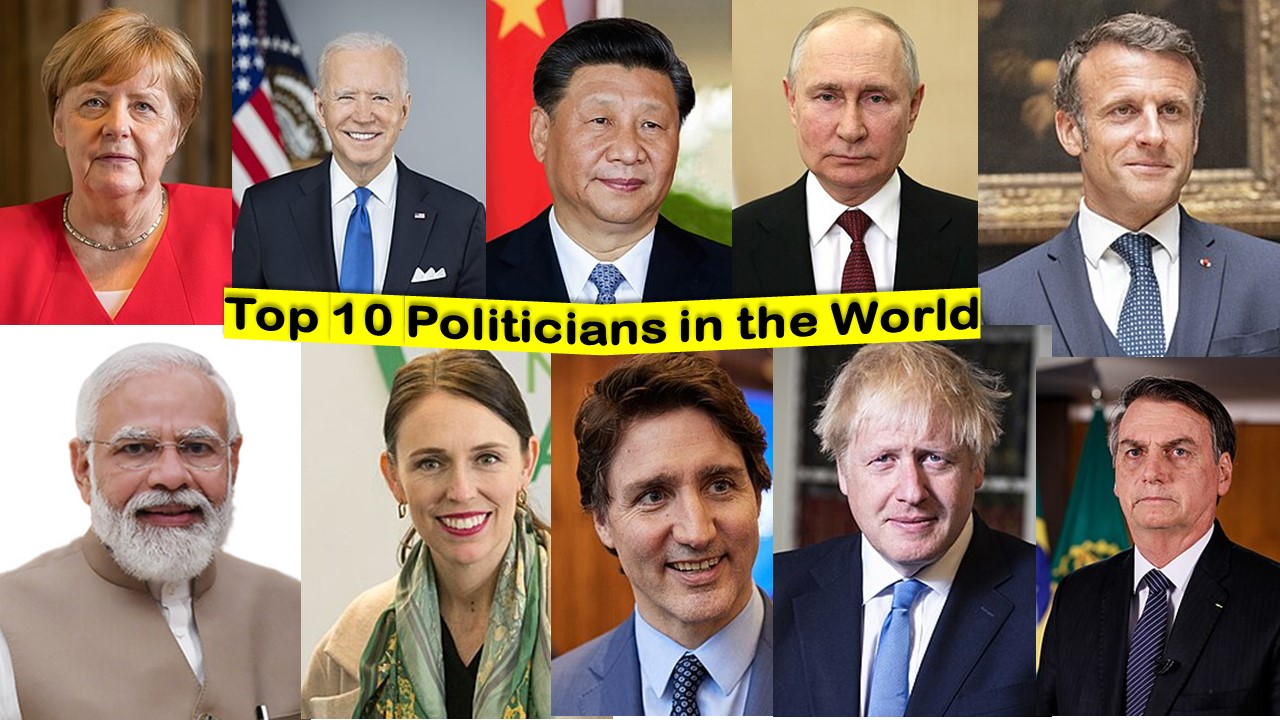
Introduction and List for Top 10 Politicians in the World
Please note that political landscapes are subject to change, and some of these individuals may no longer be as relevant or may have been replaced by new figures by the current date in 2023. Nevertheless, here is an introduction to ten prominent politicians from around the world as of 2021:
- Angela Merkel (Germany) – Angela Merkel served as the Chancellor of Germany from 2005 to 2021. A member of the Christian Democratic Union, she was known for her steady leadership and pragmatic approach to politics.
- Joe Biden (United States) – Joe Biden became the 46th President of the United States in January 2021. He has had a long career in politics, serving as Vice President under Barack Obama and as a senator from Delaware.
- Xi Jinping (China) – Xi Jinping is the General Secretary of the Communist Party of China and the President of the People’s Republic of China since 2013. He has played a significant role in shaping China’s domestic and foreign policies.
- Vladimir Putin (Russia) – Vladimir Putin has been a dominant figure in Russian politics. He served as President from 1999 to 2008 and again from 2012 to 2024, and as Prime Minister in between those terms.
- Emmanuel Macron (France) – Emmanuel Macron was elected as the President of France in 2017. A former investment banker, Macron founded the centrist party “En Marche!” and brought a fresh approach to French politics.
- Narendra Modi (India) – Narendra Modi became the Prime Minister of India in 2014. A member of the Bharatiya Janata Party, he is known for his economic reforms and efforts to improve India’s global standing.
- Jacinda Ardern (New Zealand) – Jacinda Ardern is the Prime Minister of New Zealand since 2017. She gained international attention for her compassionate and effective handling of the Christchurch mosque shootings.
- Justin Trudeau (Canada) – Justin Trudeau has been the Prime Minister of Canada since 2015. He leads the Liberal Party and is known for his progressive policies and emphasis on diversity and inclusion.
- Boris Johnson (United Kingdom) – Boris Johnson became the Prime Minister of the United Kingdom in 2019. As the leader of the Conservative Party, he played a crucial role in the UK’s departure from the European Union.
- Jair Bolsonaro (Brazil) – Jair Bolsonaro assumed office as the President of Brazil in 2019. His presidency was marked by controversial policies and environmental issues related to the Amazon rainforest.
Please keep in mind that the political landscape is continuously evolving, and newer politicians may have emerged as significant figures in the world of politics since my last update in September 2021.
Short Information, and Wiki Links of Top 10 Politicians in the World
Angela Merkel
Angela Merkel is a German politician who served as the Chancellor of Germany from 2005 to 2021. She was born on July 17, 1954, in Hamburg, West Germany. Merkel is a member of the Christian Democratic Union (CDU) party, one of Germany’s major political parties.
Before entering politics, Merkel pursued a career in physics and earned a doctorate in quantum chemistry. She later shifted her focus to politics and joined the CDU in the late 1980s. Merkel quickly rose through the party ranks, and in 1991, she became the Minister for Women and Youth in Chancellor Helmut Kohl’s government.
Merkel’s momentous rise in German politics came after the reunification of East and West Germany. In 2005, she became the first female Chancellor of Germany, succeeding Gerhard Schröder. Merkel’s leadership style was often characterized by pragmatism, cautious decision-making, and a focus on consensus-building.
During her time as Chancellor, Merkel faced numerous challenges, including the Eurozone financial crisis and the refugee crisis that began in 2015. She was known for her steady leadership during these difficult times, earning her the nickname “Mutti” (Mom) among some Germans due to her motherly image.
As a respected and influential leader, Merkel played a significant role in European and global affairs. She advocated for the European Union’s unity and promoted cooperation among member states. Merkel’s leadership and economic policies also helped Germany maintain a robust economy, making her a prominent figure on the world stage.
In late 2021, Angela Merkel stepped down as Chancellor after serving four terms, and she did not seek re-election. Her departure marked the end of an era in German politics, and she left a lasting impact on her country and the world. Merkel’s legacy includes being one of the most powerful women in politics and a symbol of stability during challenging times.
Joe Biden
As of my last knowledge update in September 2021, Joe Biden was the 46th President of the United States. Born on November 20, 1942, in Scranton, Pennsylvania, Biden has had a long and distinguished career in American politics.
Before assuming the presidency, Biden’s political journey began in 1973 when he became the United States Senator from Delaware. He served in the Senate for an impressive 36 years, making him one of the longest-serving senators in U.S. history. During his tenure, Biden played key roles in shaping various legislations, with a particular focus on foreign policy, criminal justice, and environmental issues.
In 2008, Biden was chosen as the Vice Presidential running mate for Barack Obama, the Democratic Party’s nominee for President. Obama and Biden won the election and took office in January 2009. As Vice President, Biden was known for his close relationship with President Obama and his involvement in various initiatives, including the implementation of the Affordable Care Act (Obamacare) and efforts to address the economic recession.
In the 2020 United States presidential election, Joe Biden ran for President as the Democratic Party’s nominee. He faced off against the incumbent President Donald Trump. Biden’s campaign emphasized unity, restoring democratic norms, and addressing issues like healthcare, climate change, and racial inequality.
On January 20, 2021, Joe Biden was inaugurated as the 46th President of the United States. His presidency began during a challenging time, as the country grappled with the COVID-19 pandemic, economic uncertainty, and political divisions. Biden’s administration prioritized the national response to the pandemic, launching vaccination campaigns and economic recovery plans.
Throughout his political career, Joe Biden has been seen as a moderate and pragmatic politician, known for his ability to reach across the aisle and work with lawmakers from both parties. As President, he aimed to restore America’s role in the international community, rejoining the Paris Agreement and strengthening alliances with traditional allies.
Please note that events and developments in politics can change rapidly, and it’s essential to consult more recent sources for the latest information on Joe Biden and his presidency beyond September 2021.
Xi Jinping
Xi Jinping is the General Secretary of the Communist Party of China (CPC) and the President of the People’s Republic of China. He has been one of the most prominent and powerful figures in Chinese politics since assuming these leadership positions in 2012.
Xi Jinping was born on June 15, 1953, in Beijing, China. He is the son of Xi Zhongxun, a revolutionary hero and former Vice Premier of China, which gave him significant political connections and experience from an early age.
Xi Jinping’s rise to power within the Communist Party was gradual but steady. Before becoming China’s paramount leader, he held various provincial-level leadership positions, including being the Governor of Fujian Province, the Secretary of Zhejiang Provincial Committee, and the Party Secretary of Shanghai.
In November 2012, Xi was officially anointed as the General Secretary of the Communist Party of China, succeeding Hu Jintao. Subsequently, in March 2013, he was elected as the President of the People’s Republic of China by the National People’s Congress, China’s top legislative body.
During Xi Jinping’s leadership, China witnessed a consolidation of power under his administration. He promoted the notion of “Xi Jinping Thought” and his signature policies such as the “Chinese Dream,” emphasizing national rejuvenation, economic development, and modernization. Under his watch, China also launched the ambitious Belt and Road Initiative (BRI) aimed at enhancing global connectivity and trade.
Internationally, Xi Jinping sought to strengthen China’s influence and presence on the global stage. He played a central role in shaping China’s foreign policy and took an active stance on issues like territorial disputes in the South China Sea and the relationship with the United States.
However, Xi’s tenure has also been marked by increased control and centralization of power, leading some to raise concerns about human rights issues and restrictions on freedom of speech and expression within China.
It’s important to note that political landscapes can evolve rapidly, and new developments may have occurred since my last update in September 2021. For the most up-to-date information on Xi Jinping and his role in Chinese politics, I recommend consulting more recent and reliable sources.
Vladimir Putin
Vladimir Putin is a prominent Russian politician and the President of Russia. He has been a dominant figure in Russian politics for many years, serving as both President and Prime Minister.
Vladimir Vladimirovich Putin was born on October 7, 1952, in Leningrad (now Saint Petersburg), Russia. He had a background in the Soviet security apparatus, working as an officer in the KGB, the Soviet Union’s main security agency. After the dissolution of the Soviet Union in 1991, Putin entered politics in the newly formed Russian Federation.
Putin’s rise to power began when he was appointed as Prime Minister by President Boris Yeltsin in 1999. Later that year, Yeltsin resigned, and Putin became the Acting President. He won the presidential election in 2000 and served as President until 2008. During this period, Putin was known for his assertive leadership style and efforts to stabilize Russia’s economy and political system after a period of uncertainty.
After serving two terms as President, which is the constitutional limit, Putin became Prime Minister in 2008, with Dmitry Medvedev as the President. In 2012, Putin was elected President again and re-assumed the highest office in Russia, serving until 2024.
Throughout his tenure, Putin has been credited with restoring Russia’s global standing and overseeing economic growth. However, his rule has also faced criticism for curbing political opposition and restricting press freedoms.
Under Putin’s leadership, Russia has been involved in various international affairs, including conflicts in Ukraine and Syria, and has engaged in geopolitical disputes with Western nations.
It’s important to note that my information is up to date only until September 2021, and developments may have occurred since that time. Vladimir Putin’s political status and actions may have changed since then. For the latest information, I recommend consulting current and reliable sources.
Emmanuel Macron
Emmanuel Macron is the President of France. Born on December 21, 1977, in Amiens, France, Macron is a former investment banker and a centrist politician who founded the political movement “En Marche!” (On the Move) in 2016.
Before becoming President, Macron served as a senior civil servant and an economic advisor to President François Hollande. He also briefly held the position of Minister of Economy, Industry, and Digital Affairs in the French government.
Emmanuel Macron’s rise to prominence came when he launched his independent presidential campaign in 2017. Running on a platform of economic reform, pro-Europeanism, and social liberalization, he positioned himself as a political outsider seeking to transcend traditional left-right divides in French politics.
In the 2017 French presidential election, Macron advanced to the second round and faced Marine Le Pen, the leader of the far-right National Rally party. Macron secured a decisive victory in the runoff, becoming the youngest President in French history.
As President, Macron implemented various economic reforms aimed at liberalizing the labor market, reducing public spending, and encouraging entrepreneurship. He also advocated for stronger European integration and played an active role in European and international affairs.
During his presidency, Macron faced challenges, including protests from various groups dissatisfied with his policies, such as the “Yellow Vest” movement, which protested against fuel tax hikes and perceived economic inequality.
Macron’s presidency has been marked by efforts to address climate change, promote gender equality, and engage in diplomatic initiatives on global issues.
As political landscapes can evolve rapidly, I recommend consulting more recent sources for the latest information on Emmanuel Macron and his current role in French politics beyond September 2021.
Narendra Modi
Narendra Modi is the Prime Minister of India. Born on September 17, 1950, in Vadnagar, Gujarat, India, Modi is a prominent leader in the Bharatiya Janata Party (BJP) and a key figure in Indian politics.
Before entering politics, Narendra Modi served as a member of the Rashtriya Swayamsevak Sangh (RSS), a Hindu nationalist organization. He later joined the BJP and held various organizational positions within the party.
Modi’s political career gained significant momentum when he became the Chief Minister of Gujarat, India’s western state, in 2001. He served as the Chief Minister until 2014, during which time Gujarat experienced rapid economic growth and infrastructure development.
In 2014, Narendra Modi led the BJP to a historic victory in the Indian general elections, and he became the 14th Prime Minister of India. His campaign focused on promises of economic reforms, development, and good governance.
As Prime Minister, Modi pursued various policy initiatives, including the “Make in India” campaign to boost manufacturing, the “Digital India” program to enhance technology adoption, and the “Swachh Bharat Abhiyan” to promote cleanliness and sanitation.
Modi’s administration also undertook major economic reforms such as the implementation of the Goods and Services Tax (GST) and the demonetization drive, which aimed to curb corruption and black money but also faced criticism for its short-term economic impact.
During his tenure, Modi’s foreign policy emphasized strengthening India’s global standing and enhancing relationships with other countries. He played an active role in international forums, promoting India as an attractive destination for investment and cooperation.
Modi’s leadership has also faced criticism, particularly regarding issues related to religious tensions, freedom of speech, and minority rights in India.
In the 2019 general elections, Narendra Modi led the BJP to another resounding victory, securing a second term as Prime Minister.
Jacinda Ardern
Jacinda Ardern was the Prime Minister of New Zealand. Born on July 26, 1980, in Hamilton, New Zealand, Ardern is a prominent politician and leader of the New Zealand Labour Party.
Ardern’s political career began when she joined the Labour Party at a young age and later worked as an advisor to former Prime Minister Helen Clark. She was elected as a Member of Parliament in 2008, representing the electorate of Mount Albert.
In August 2017, just a few months before the general elections, Ardern was elected as the leader of the Labour Party, replacing Andrew Little. Her ascent to the leadership position marked a significant turning point for the party, as she brought in a fresh and energetic approach to politics.
In the 2017 New Zealand general elections, Jacinda Ardern led the Labour Party to a notable comeback, and her party formed a coalition government with the New Zealand First Party and the Green Party. At 37 years old, she became the youngest female leader in New Zealand’s history and the country’s third female Prime Minister.
Ardern’s leadership style has been characterized by compassion, inclusivity, and decisive action. She gained international recognition for her empathetic response and leadership in the aftermath of tragic events, notably the Christchurch mosque shootings in March 2019.
During her tenure as Prime Minister, Ardern’s government focused on various policy areas, including addressing child poverty, tackling climate change, and promoting social and economic equality. She also led New Zealand’s response to the COVID-19 pandemic, implementing strict border controls and lockdown measures that earned praise for effectively controlling the spread of the virus.
Ardern’s leadership during times of crisis and her progressive policies have made her a popular figure both domestically and internationally. She has been an advocate for issues such as mental health, women’s rights, and global action on climate change.
Justin Trudeau
Justin Trudeau is the Prime Minister of Canada. Born on December 25, 1971, in Ottawa, Ontario, Trudeau is a prominent Canadian politician and leader of the Liberal Party of Canada.
Justin Trudeau’s entry into politics was greatly influenced by his father, Pierre Elliott Trudeau, who was also a former Prime Minister of Canada. Trudeau’s early career included teaching and working as a public speaker, but he entered the political arena in 2008 when he was elected as the Member of Parliament (MP) for the Montreal riding of Papineau.
Trudeau’s leadership ambitions came to the forefront in 2013 when he won the leadership of the Liberal Party. He brought a fresh and dynamic approach to politics, emphasizing progressive policies, social inclusivity, and environmental issues.
In the 2015 Canadian federal election, Trudeau led the Liberal Party to a decisive victory, becoming Canada’s 23rd Prime Minister. His campaign promised positive change, economic growth, and a commitment to diversity and reconciliation with Indigenous peoples.
As Prime Minister, Trudeau’s government introduced various policies and initiatives. Notably, the government implemented a significant infrastructure spending program, legalized recreational cannabis, and focused on increasing support for families and the middle class.
Trudeau has been vocal about Canada’s commitment to addressing climate change, and his government implemented carbon pricing and other environmental measures.
Trudeau’s tenure has not been without challenges, including controversies related to ethics and governance. Nevertheless, he maintained significant popularity among certain segments of the Canadian population, particularly among young voters.
In the 2019 Canadian federal election, Trudeau’s Liberal Party secured a second term, forming a minority government.
As political landscapes can change rapidly, it is essential to consult more recent sources for the latest information on Justin Trudeau and his current role in Canadian politics beyond September 2021.
Boris Johnson
Boris Johnson was the Prime Minister of the United Kingdom. Born on June 19, 1964, in New York City, United States, Johnson is a prominent British politician and leader of the Conservative Party.
Before entering politics, Johnson pursued a career in journalism and served as the editor of The Spectator, a prominent British magazine. He later transitioned into politics and was elected as the Member of Parliament (MP) for Henley in 2001. Johnson’s charismatic and sometimes controversial style quickly made him a well-known figure in British politics.
In 2008, Johnson became the Mayor of London, serving two terms until 2016. During his time as Mayor, he was known for promoting various infrastructure projects and initiatives to improve transportation and public services in the city.
In July 2019, Boris Johnson was elected as the leader of the Conservative Party, succeeding Theresa May. Shortly after becoming the party leader, he assumed the position of Prime Minister after winning a leadership contest within his party.
As Prime Minister, Johnson’s tenure has been marked by significant political challenges, most notably the negotiations and aftermath of Brexit, the United Kingdom’s withdrawal from the European Union. Johnson led the “Leave” campaign during the 2016 Brexit referendum and made a commitment to delivering Brexit.
In January 2020, the UK officially left the European Union, entering a transitional period during which negotiations took place to establish the future relationship between the UK and the EU.
Throughout his time as Prime Minister, Johnson has faced criticism and political divisions over issues such as Brexit, handling of the COVID-19 pandemic, and domestic policy matters.
It’s important to note that political landscapes can evolve rapidly, and new developments may have occurred since my last update in September 2021. For the latest information on Boris Johnson and his current role in British politics, I recommend consulting more recent and reliable sources.
Jair Bolsonaro
Jair Bolsonaro was the President of Brazil. Born on March 21, 1955, in Glicério, São Paulo, Bolsonaro is a Brazilian politician and former military officer who became a significant and controversial figure in Brazilian politics.
Bolsonaro served in the Brazilian military before entering politics. He was elected as a Member of the Brazilian Chamber of Deputies in 1991 and served several terms as a congressman before running for the presidency.
In the 2018 Brazilian presidential election, Bolsonaro ran as the candidate of the Social Liberal Party (PSL). His campaign focused on issues such as combating crime and corruption, promoting conservative social values, and advocating for a strong stance on law and order.
Bolsonaro’s presidency has been marked by policies that appealed to his conservative base. He pursued reforms in areas such as the economy, social security, and labor laws. His administration also took steps to address crime and violence, including implementing a controversial law to ease gun ownership.
However, Bolsonaro’s presidency has faced criticism and controversy on multiple fronts. Environmentalists and international leaders have expressed concerns about his approach to the Amazon rainforest and his stance on climate change. Additionally, Bolsonaro’s handling of the COVID-19 pandemic received both support and criticism, and Brazil faced significant challenges during the health crisis.
His rhetoric and policies have often sparked polarizing debates within Brazil, and his administration has faced political tensions and challenges.
As political landscapes can change rapidly, I recommend consulting more recent sources for the latest information on Jair Bolsonaro and his current role in Brazilian politics beyond September 2021.
Keynotes on Top 10 Politicians in the World
here are some keynotes on the top 10 politicians in the world. Please note that political landscapes can change rapidly, and the relevance and positions of these politicians may have evolved since then.
- Angela Merkel (Germany): Merkel was a long-serving Chancellor of Germany, known for her steady leadership and pragmatic approach. She played a crucial role in European politics and was respected for her handling of various crises.
- Joe Biden (United States): Biden became the 46th President of the United States in January 2021. He has had a long career in politics and is known for his emphasis on unity and cooperation in governance.
- Xi Jinping (China): As the General Secretary of the Communist Party of China and the President of the People’s Republic of China, Xi Jinping wielded significant influence both domestically and on the global stage.
- Vladimir Putin (Russia): Putin has been a dominant figure in Russian politics, serving as both President and Prime Minister. His leadership has been marked by assertiveness in foreign affairs and efforts to strengthen Russia’s position in the world.
- Emmanuel Macron (France): Macron became the President of France in 2017, representing a centrist approach to politics. He focused on economic reforms and strengthening European unity.
- Narendra Modi (India): As the Prime Minister of India, Modi emphasized economic reforms, digitalization, and global engagement to improve India’s standing in the world.
- Jacinda Ardern (New Zealand): Ardern, as the Prime Minister of New Zealand, gained international attention for her compassionate leadership and decisive actions during crises, including the response to the Christchurch mosque shootings.
- Justin Trudeau (Canada): Trudeau, as the Prime Minister of Canada, advocated for progressive policies, environmental action, and diversity and inclusion.
- Boris Johnson (United Kingdom): Johnson, as the Prime Minister of the United Kingdom, led efforts on Brexit negotiations and domestic policy reforms.
- Jair Bolsonaro (Brazil): Bolsonaro’s presidency in Brazil was marked by controversial policies and handling of issues like the Amazon rainforest and the COVID-19 pandemic.
Further Readings for Top 10 Politicians in the World
- News Outlets: Reputable news websites and publications often have sections dedicated to politics and world leaders. Searching for the names of these politicians on reliable news platforms can provide you with the latest developments and analyses.
- Official Government Websites: Many countries have official government websites with detailed profiles of their leaders, including their policies, speeches, and official statements.
- Biographies and Autobiographies: Some of the top politicians may have published biographies or autobiographies that offer insights into their lives, careers, and political ideologies.
- Political Analysis and Opinion Pieces: Political commentators and analysts frequently discuss and analyze the actions and impact of top politicians. Searching for articles or opinion pieces can provide in-depth analyses of their policies and leadership.
- Academic Journals and Research Papers: Scholarly articles and academic journals often feature research on political leaders and their policies, offering more objective insights into their roles on the global stage.
- Social Media: Many politicians maintain active social media accounts, through which they share updates, speeches, and policy initiatives. Social media platforms can provide direct access to their official statements and actions.
- Books on Global Politics: Books that focus on international politics and diplomacy may also mention or discuss the impact of top politicians on global affairs.